Tuesday, August 7, 2012

Less is more: space,light, air

There's a moment in mid-summer when everything in the garden seems at a peak of bloom and size, then suddenly one day, maybe after a rain storm, the plants looks crowded and messy, leaning into each other, some covered over entirely. Although I love grey-leaved plants such as Artemesia and Lamium, garden experts always warn against their spreading invasive habits and this year I have to agree with them. The answer is to pull them out when they start to take over, leaving just enough to spread next year. So, starting with a small area I weeded anything out that looked as though it was crowding other plants and I focused on creating more space and light in the border. Air circulation is important for healthy plants. Some perennials, such as Monarda, will be more likely to acquire mildew on the leaves if overcrowded.
Part of the border showing evidence of weeding and thinning, making sure air gets to the plants up against the fence.


I'm interested in plants that arrive by chance in the garden from birds or wind or squirrels, so when weeding I usually leave things that I'm not sure about. The big grey-green leaves of the wildflower Verbascum appeared in an interesting place along the stone steps of a path. I have left them there to see what they will do. I will have to wait to see until next year when they will sprout a tall, yellow-flowered stalk.


Reward at the end of a day of weeding

Wednesday, July 18, 2012

Butterflies

 Part of the joy of gardening is observing the wildlife that plants attract. Insects and birds are always in my mind when I am choosing what to plant. For inspiration I am grateful for the Nyack Garden Club's beautiful Butterfly Garden in Memorial Park on the Hudson. It is a small space, lovingly maintained and filled with mostly native plants, complete with labels, so it is truly a teaching garden.
Yellow swallowtail
This time of year the butterflies visit my garden all day into early evening. They are especially attracted to Buddleia davidii (above), Monarda didyma and Echinacea purpurea.
Black swallowtail 


The monarchs (left) have started to arrive. If I had milkweed in the garden they might lay their eggs on its leaves. But this one will seek it out in the wild places it prefers to grow.

Below, a beautiful deep yellow butterfly that kept returning to this plant for most of one morning.


 This white butterfly arrives in small groups, here seen at rest and fluttering its wings around the Agastache, Anise Hyssop.


Not a butterfly! For several days at dusk the goldfinches have been coming to the Centaurea cyanus, eating, I think, the seed from the faded blossoms. The birds are so delicate they barely weigh down the thin flower stalks.


I have been waiting all summer for a hummingbird. Finally one appeared last week. Here is blurry picture of it approaching the Monarda. I am hoping this wonderful creature will make the garden a regular stop on its neighborhood route.

Friday, July 6, 2012

Summer Border


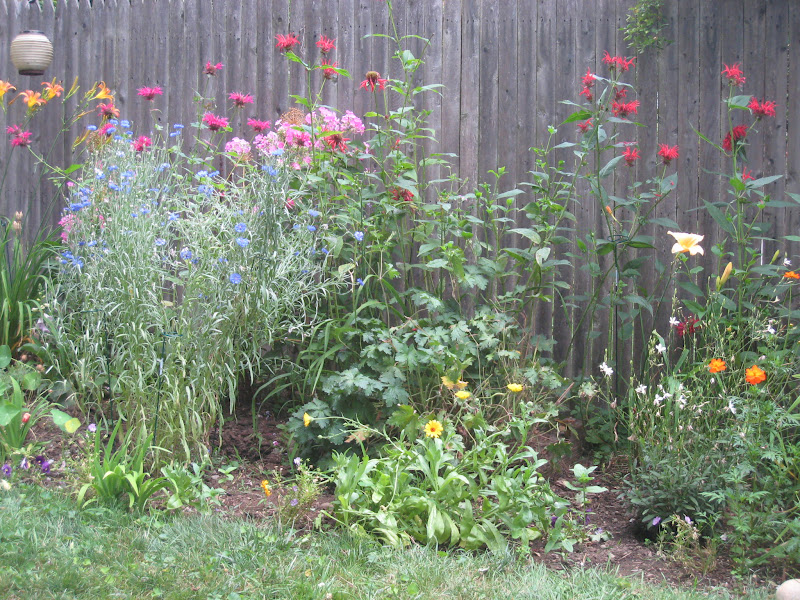
The mild winter, very warm spring, a few strong downpours and frequent showers have helped plants mature very quickly. Many of them are blooming earlier than their normal time, creating an explosion of color. I have planted several varieties of Monarda (bee balm) in hopes of visits from hummingbirds. This border faces south. The photo was taken facing west.
 Here, surrounding the sundial are two kinds of Monarda, 'Raspberry Wine,' and 'Pink Lace.'  yellow and red daylilies, Echinacea purpurea 'Ruby Star', 'Gaura lindheimeri', Coreopsis viticella 'Moonbeam,' and annual orange Cosmos.


Annual cornflowers Centaurea cyanus, Calendula, and orange Cosmos in front of of several varieties of daylilies, Monarda,  pink Phlox paniculata (unnamed, inherited from my grandmother), white Gaura lindheimeri - a lovely little shrubby perennial with flowers that resemble small butterflies.
More cornflowers, Cosmos and Calendula with Echinacea, Artemisia and Perovskia atriplicifolia 'Russian Sage.'
Next to the sundial are potted blue Agapanthus, pink yarrow Achillea 'Little Susie,' - far right Perovskia and Artemisia 'Silver Queen'.  


A hidden feature of the garden are the many flower supports helping to prevent the tendency for most of the medium height and tall plants to flop over in heavy rain and wind. The cornflowers and bee balm are especially floppy, but even the more stiff-stemmed Echinacea will topple if not supported. Photo at left shows a simple solution available at most garden centers.  I like this kind because they come in three different heights, are easy to push into the soil, and once in place allow the plant to retain its normal shape.

Saturday, June 16, 2012

Pansies near the solstice


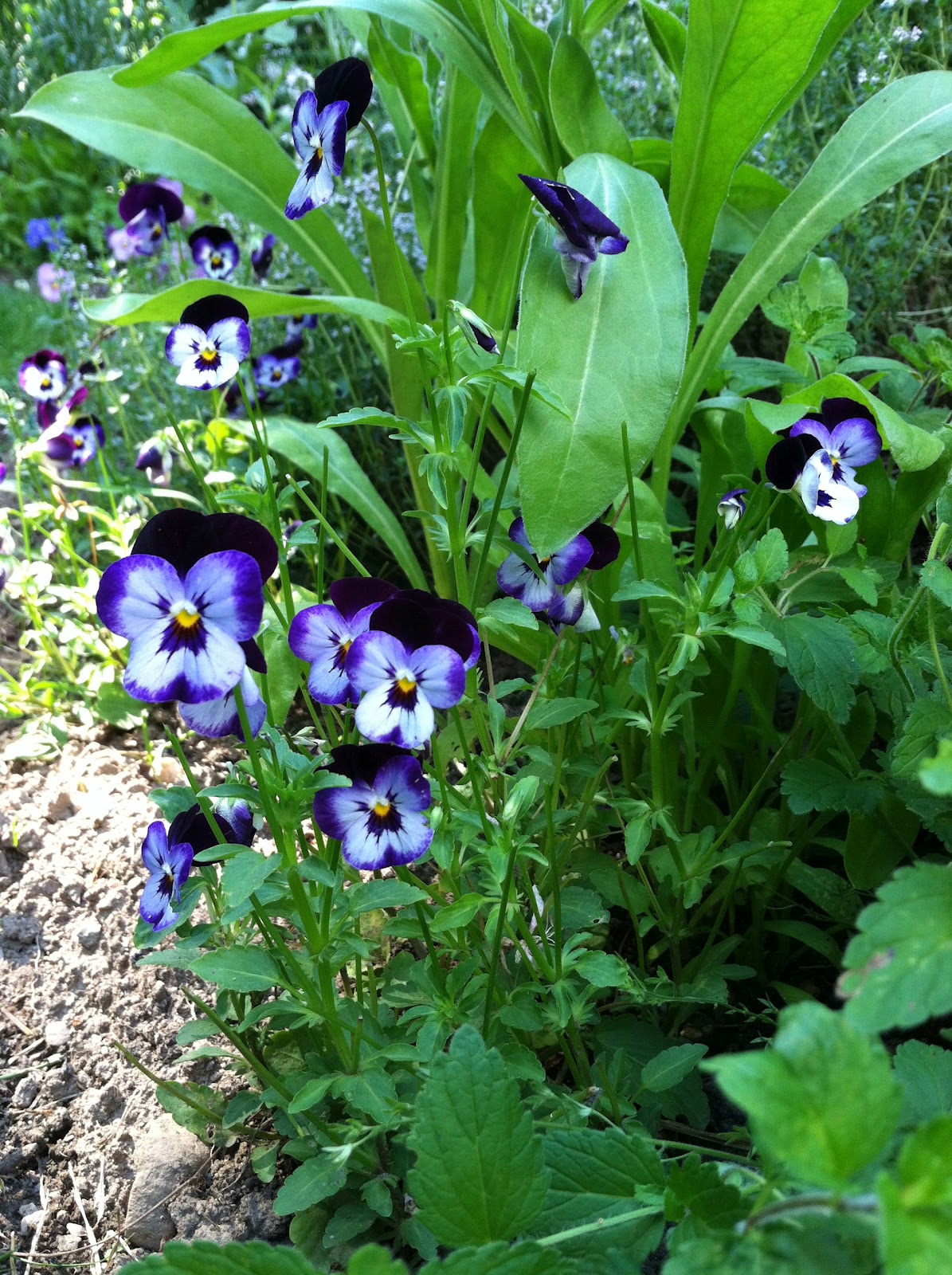
I loved pansies as a child, mostly, I think, because my grandmother urged me to pick them, telling me that the more they are picked the more they will bloom. Very true! What I appreciate about them now is that as spring turns to summer the blooms get smaller and decidedly more dainty as long as they are deadheaded regularly.

Here they are getting engulfed by calendulas, bachelor's buttons and zinnias. Sometimes pansies will seed themselves for the next year in which case they will often revert to their original form, the wild Viola tricolor 'Johnny jump-up', the ancestor of the modern pansy.

Friday, June 15, 2012

Shade

Shade gardening can be challenging because it can seem as though there are fewer options for successful plants in that environment than one with full sun. The great thing about shade, however, is that the filtered light enhances the contrasting greens and the textures and shapes of leaves.  In this corner of my garden there are about two hours of sun in the early morning this time of year. In the upper left are the big leaves of Sanguinaria canadensis (blood root), which blooms in earliest spring with a beautiful white flower. Below it is Arthyrium niponicum (Japanese painted fern), white Astilbe, a fern, Hosta sieboldiana, and a small pinkish Astilbe. The ground covers are Galium odoratum (sweet woodruff), Phlox divaricata which blooms with blue/purple flowers in spring, and just getting started Lysimachia nummularia (Creeping Jenny or Moneywort) which will have tiny yellow flowers. All of these plants will spread in time and can be divided for planting in other parts of the garden.  The purple flower is an annual, Scaveola, which I found in the shade section of a garden center and then read the label when I got home - 'full sun!' I planted it here anyway just to see what would happen. I like the way the blue-green of the Hosta mirrors the color of the bronze cat's head.

Astilbe, ferns and Galium odoratum (sweet woodruff) around a bird bath in front of a wooden sculpture. Later in the summer the plumes of the Astilbe loose their color, but the dried flowers can still have a feathery look.


Another bird bath, the favorite of the blue jays and catbirds, with painted fern, Vinca, and Heuchera ,just to the left of the fern, and some white impatiens.

A catbird enjoys a bath


I'm just now figuring out what to do with this space, making a small path, experimenting with small hostas,  Alchemilla mollis (Ladies mantle), ferns and the ground cover Lamium maculatum 'Ghost' which will spread prolifically. I'll probably move things around here during the summer.  Despite what gardening experts say, I move plants whenever I decide they should be in a different place, even if they are in full bloom. With regular watering they usually recover from the initial shock.

Thursday, June 7, 2012

Poppies


    Several years ago a friend gave me seeds from poppies growing on an island in Gloucester MA. I scattered them over the bare ground in late fall and in early spring their blue-green leaves were sprouting everywhere.  Each year since I have collected their seeds in the late summer for fall sowing, although they would probably self seed if left alone. They are Papaver somniferum, the opium poppy, which grows wild in many parts of the world, particularly Asia Minor. Media images of immense poppy fields in Afghanistan are startling reminders of the power of plants for good or evil. My friend and I call them Island Poppies and they add a wonderful wildness to the spring garden.A seed landed in the creeping thyme and the poppy grew up to be a companion for someone sitting on the bench. Photo below shows the seed pod in back of the bloom. The seeds ripen later in the summer and the pod dries to become an exquisite shaker.

Tuesday, June 5, 2012

Plant Combinations

I like to use grey-leaved plants to bring out the color in yellow, blue and purple flowers. Here Stachys byzantina (Lambs' ears), and Artemesia 'Silver King', frame the daylily Hemerocallis flava, Geranium 'Brookside' and purple pansies, all nestled around a little stone owl. In some lights the Geranium is more blue than purple.
 More grey leaves, including Perovskia atriplicifolia (Russian sage), and Nepeta 'Walker's Low' (catmint) both of which make wonderful combinations with greens and brighter flowers during the summer.
Japanese iris (will have purple flowers later), Adiantum podatum (Maidenhair fern), and Galium odoratum (Sweet woodruff) around a terracotta sculpture of St. Fiacre, the patron saint of gardening.
Here the different bright greens and textures make a great combination for part shade. All these plants came from my garden in New England and they have prospered in their new soil. I am hoping the ferns will spread in time because they are particularly beautiful as a groundcover.